


Delta wool dog coat
- In stock
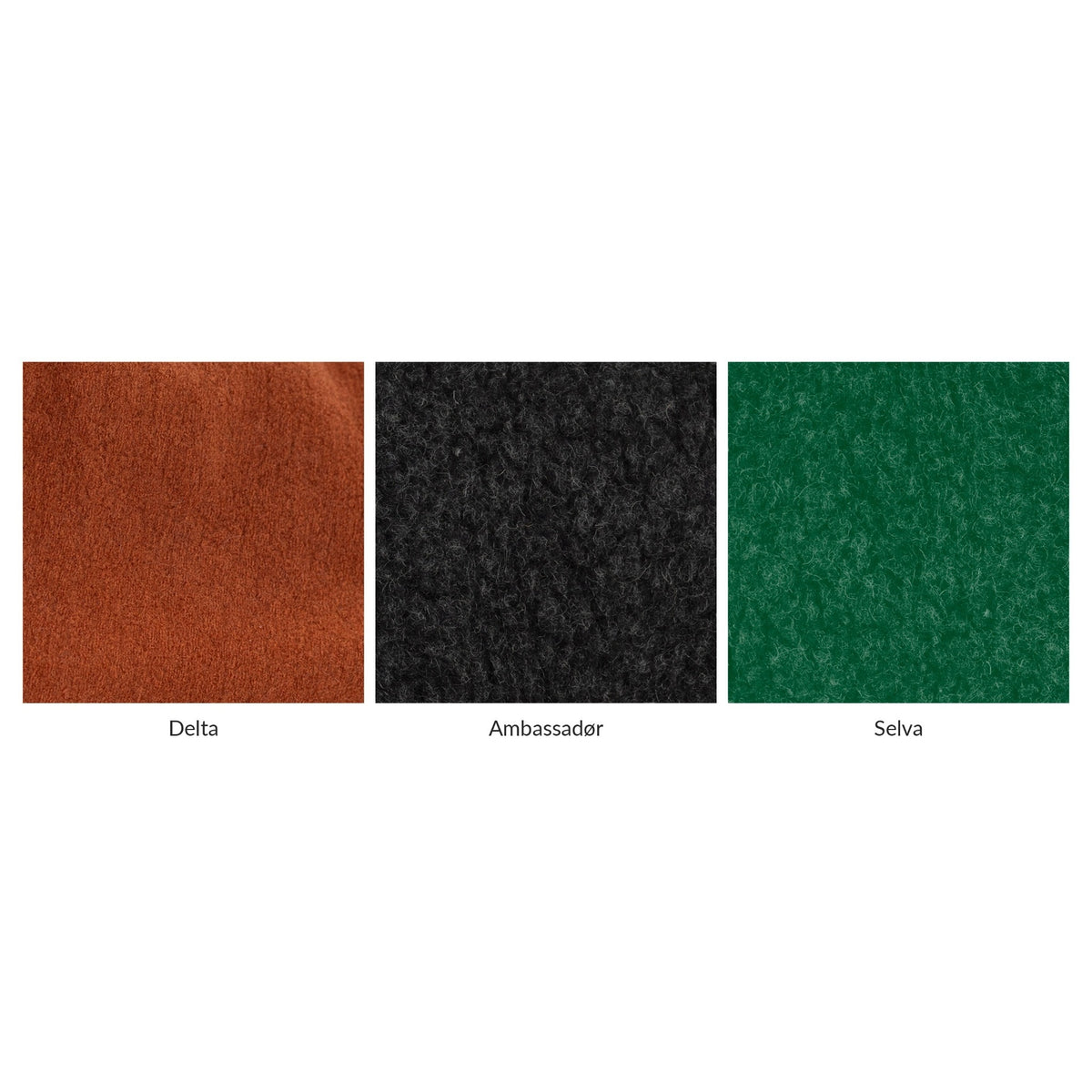
Delta is a thin wool dog coat in 100% merino wool that can be used all year round. It keeps the dog snug and comfortable before, during and after walks, in the car and through cold evenings and nights. The fabric in Delta is "flat", unlike Ambassador and Selva, which have a "pile". The fabric in Delta is the same as that used in the Fjord wool jacket and the Stasch vest.
Why choose a wool dog coat?
Wool has three fantastic properties: it warms, insulates and breathes. Keeping the dog's muscles warm before and after walks and training can help prevent injuries and speed up recovery. This way, the dog's body does not need to waste energy keeping its temperature up.
A wool coat is excellent between runs at hunting trials and is useful for all dogs, whatever the breed. Older dogs and dogs with injuries or arthritis, which often have poorer circulation and feel the cold more easily, will particularly benefit from a wool coat. Nobody likes to be cold! Wool should be the first choice for any dog on cold winter days or damp days. Slip your hand under the coat to feel whether the dog is cold or warm.
Even though the dog coat is not waterproof or windproof, it offers outstanding warmth and comfort. Wool is soft and gives the dog good freedom of movement, which makes it ideal both in the car on cold days and before or after training and walks. It is naturally antistatic and resists odour better than synthetic materials, which makes a wool coat hygienic and practical to use.
Unsure which size to choose?
Our coat sizes are given as the dog's back length in centimetres. Measure your dog and choose the size with the same back length. Then you are well on your way to a coat that fits as it should.
How to measure your dog

- Start between the shoulder blades. Let the dog stand straight and calm, and find the point midway between the shoulder blades.
- Measure to the bend just in front of the tail. Follow the back towards the rear to the bend where the back ends and the tail begins. Lift the tail a little – that makes the bend easier to feel.
- Measure along the back. Use a soft tape measure and let it follow the shape of the back.
Tip: A coat that is slightly long is better than one that is too short.
What do the measurements mean?
- The size, for example M 45 cm, is the dog's back length – measured between the two points in the illustration.
- On the coat, this corresponds to the length from the neck adjustment to the middle of the dart sewn at the rear of the coat (regular model), or to the curved cut-out for the tail (terrier model).
- The coat's total length, from the neck adjustment all the way to the end, is 10–15% longer than the size measurement. This is because it is meant to cover the hips and down over the hindquarters.
- The neck adjustment should sit right at the base of the neck, slightly in front of the shoulder blades. On the regular model, the base of the tail should be roughly in the middle of the rear dart.
Regular model or terrier model?
Many of our coat models come in two versions. Both are measured the same way, but they are shaped differently at the rear.
Regular model


Suits: dogs that carry their tail low or straight back.
Rear shape: the coat goes all the way back and lies over the base of the tail, the hips and the thighs.
Rear adjustment: yes – the coat is tightened at the rear so that it lies down over the thighs and hindquarters.
Terrier model


Suits: dogs that carry their tail up, and dogs that do not like anything lying over the tail.
Rear shape: rounded cut-out for the tail, so the tail moves completely freely.
Rear adjustment: no – the terrier model has no rear adjustment.
The terrier model is a good choice for many terriers, Danish-Swedish farmdogs, poodles and other dogs with a high tail carriage. If you are unsure, look at how your dog carries its tail on walks.
Dachshund sizes
Some models also come in dedicated dachshund sizes. These are adapted for dachshunds and other short-legged dogs with long backs, so the coat fits well at the front and does not hang too far down the sides. Back length is measured the same way as for other dogs.
How to put the coat on
- Slip the coat over the head.
- Pull it slightly forward and up, and tighten the neck to a comfortable fit.
- Fasten the part that goes under the chest and over the back.
- Fasten the part that goes between the front legs, and adjust the elastic if needed.
- Regular model: tighten at the rear so the coat lies down over the thighs and hindquarters. The terrier model has no rear adjustment.
- If the coat has leg elastics, lift one hind leg at a time and guide it through the elastic. The leg elastics help keep the coat in place at the rear.
How should you wash and care for a wool dog coat?
The great advantage of wool is that it is in many ways self-cleaning and sustainable, but there are several things you should be aware of when washing and caring for it.
-
We recommend shaking it and airing it outdoors in fresh air for a couple of hours. Dirt usually does not penetrate the wool fibres, but stays on the surface.
-
When washing, we recommend machine washing on a wool programme at 30 degrees with a dedicated wool detergent.
-
Wash wool products separately for the best result.
-
Preferably avoid hand washing, as it can be difficult to control the temperature and remove soap residue and dirt compared with machine washing.
-
Spinning also makes the wool fabric dry faster and creates poorer conditions for bacterial growth.
Couldn't load pickup availability

Delta wool dog coat